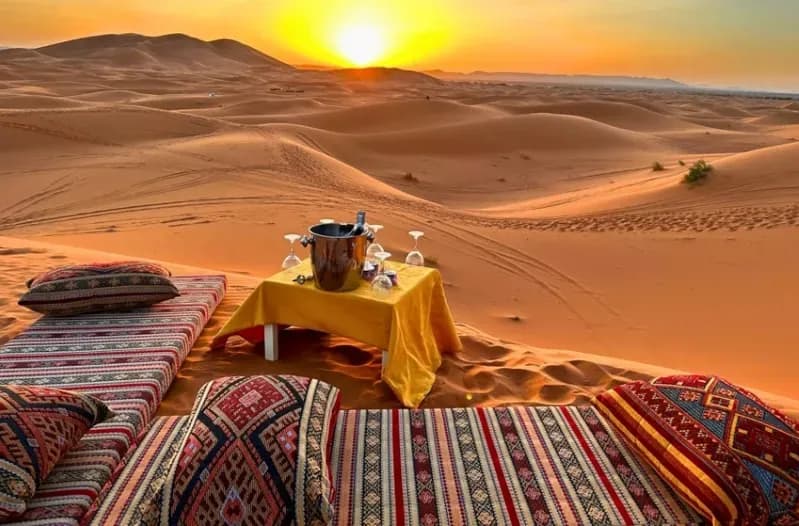
There is a moment that every traveler to Morocco's Sahara desert describes the same way. You have climbed to the top of a dune — your legs burning, your shoes full of sand — and you turn around. In every direction there is nothing but silence and an ocean of orange dunes stretching to the horizon. No road. No building. No sound except the wind reshaping the sand beneath your feet. It lasts maybe thirty seconds before someone calls your name, but you will remember it for the rest of your life.
The Sahara Desert is the reason many people visit Morocco. It is not just an experience — it is the experience. And yet most travelers arrive without knowing what they are actually booking, what the different options mean, what a good desert camp looks like versus an overpriced one, or how to organize the journey without wasting two of their precious travel days sitting in the wrong vehicle going to the wrong place.
This guide answers every question. It is written by people who have organized desert trips for hundreds of international visitors and who know the difference between a memorable Sahara experience and a disappointing one. If you want to skip the research and have everything planned for you, the team at TravelEasyLife.com handles all of it — transport, camp booking, timing, and custom itineraries for every budget.
Where Exactly Is the Sahara Desert in Morocco?
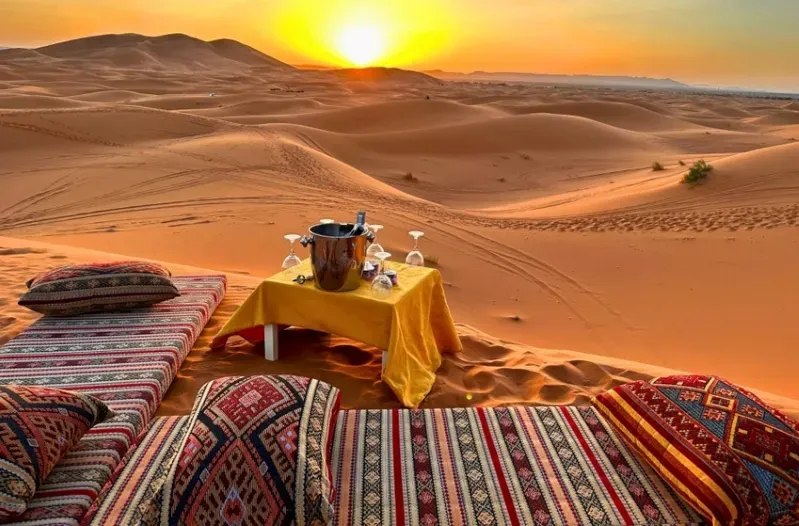
Morocco's most famous desert destination is Merzouga, a small village in the southeastern part of the country, at the foot of the Erg Chebbi dunes. Erg Chebbi is a field of sand dunes that rises up to 150 meters high, runs approximately 22 kilometers long, and 5 kilometers wide. It is one of only two large erg fields in Morocco — the other being Erg Chigaga, near M'Hamid, which is more remote and less visited.
When people search for "Morocco Sahara desert tour" or "camel trekking Morocco," they are almost always talking about Merzouga and Erg Chebbi. This is where the majority of desert camps operate, where the most spectacular dunes are accessible without a four-wheel drive, and where the infrastructure for tourism — guesthouses, camel operators, bivouac camps — is most developed.
Merzouga is located approximately 550 kilometers from Marrakech and 340 kilometers from Fes. Neither city is close. This distance is important to understand before you plan your trip, because it determines everything about how long you need and how you should get there.
How to Get to Merzouga: Your Real Options
This is where most travelers make their first mistake. They underestimate the journey and try to rush it, which means they spend more time in a vehicle than in the desert itself.
The drive from Marrakech to Merzouga takes between nine and ten hours on a good day, crossing the High Atlas Mountains through the Tizi n'Tichka pass, descending through the Draa Valley, and passing through the pre-Saharan towns of Ouarzazate and Erfoud before the dunes appear on the horizon. It is one of the most beautiful road journeys in North Africa. The route from Fes takes seven to eight hours and passes through the Middle Atlas, the cedar forests of Azrou, the Ziz Valley, and the palm oasis of Errachidia.
You have three realistic options for making this journey.
The first is a private driver or small group transfer. This is the option most recommended for first-time visitors and for anyone who values flexibility. A private vehicle from Marrakech to Merzouga costs between 1,500 and 2,500 dirhams depending on the vehicle type and whether stops are included. The driver knows the road, can stop at Aït Benhaddou or the rose valley at Kelaat M'Gouna without adding significant time, and can adjust the pace based on your interest. TravelEasyLife.com arranges private transfers with experienced local drivers who speak English and French and know the route inside out.
The second option is a shared transfer or organized tour that groups you with other travelers heading the same direction. This costs around 300 to 450 dirhams per person and is the most budget-friendly overland option. The trade-off is that stops are fixed, the timing is not flexible, and you are dependent on the group's pace.
The third option is public transport via CTM buses to Ouarzazate or Erfoud, and then shared grand taxis to complete the final leg. This works and saves money, but requires patience, local knowledge of bus schedules, and adds significant time to the journey. It is not recommended for travelers with limited days or those traveling with family.
A growing number of visitors also fly directly into Errachidia Airport from Casablanca — a one-hour flight — and then take a short transfer to Merzouga. If your schedule is tight and your budget allows for it, this cuts the overland journey entirely and makes even a short desert trip genuinely feasible.
Camel Trekking vs 4x4 vs Quad Bike: Which Desert Experience Is Right for You? visit traveleasylife.com
Once you are in Merzouga, the question becomes how you want to experience the dunes themselves. There are three main options and they are genuinely different experiences, not just different price points.
Camel trekking is the classic. You ride into the dunes at sunset or sunrise, the camel moves slowly and rhythmically, you have time to watch the light change across the sand, and there is something ancient and right about entering the Sahara this way. A standard one-hour camel ride into the dunes and back costs 150 to 200 dirhams. An overnight camel trek — riding in at sunset, sleeping in a camp, riding back at dawn — is the full experience and costs between 500 and 1,500 dirhams per person depending on the camp standard.
The physical reality of camel riding is worth knowing: it is not particularly comfortable for long periods. The saddle is wooden, the movement is lurching at first, and most people find their legs and lower back are tired after an hour. For the overnight experience this is fine because you dismount at the camp and walk from there. For a multi-day camel trek deeper into the desert, it becomes genuinely challenging. Most visitors find that one to two hours on a camel is the sweet spot.
4x4 excursions are for travelers who want to cover more ground and reach parts of the erg that are inaccessible on foot or camelback. A full-day 4x4 tour of Erg Chebbi and the surrounding area — including the fossil sites, the salt lake of Dayet Srji where flamingos gather in winter, and the Gnawa music village of Khamlia — costs around 800 to 1,200 dirhams per vehicle for a half-day or full day. This is an excellent option for travelers with limited mobility or those who have already done camel trekking on a previous visit.
Quad bikes (ATVs) are popular with younger travelers who want the adrenaline element. A one-hour quad bike rental in the dunes costs around 350 to 500 dirhams. They are fun and the dunes make for extraordinary terrain, but they are also noisy, they damage the surface of the sand, and they remove the silence that makes the desert special. If the Sahara experience is meaningful to you rather than just exciting, camel trekking or a 4x4 will serve you better.
Desert Camps: What to Expect and How to Choose visit traveleasylife.com
The overnight desert camp experience is what most people are searching for when they look up "Morocco Sahara tour." The idea is simple: sleep in a Berber tent inside the dunes, eat dinner by a fire under the stars, wake at dawn and watch the sun rise over the sand. In practice, the quality varies enormously between camps.
Standard camps — which are priced between 400 and 700 dirhams per person including dinner and breakfast — typically consist of large communal tents shared between multiple people or couples, basic foam mattresses on the ground, shared bathrooms in a separate structure, and group dinner eaten together with other travelers. The experience is social and the price is accessible, but the setting is sometimes less intimate than the marketing photos suggest. Some standard camps are genuinely lovely. Others feel overcrowded in high season.
Mid-range camps — priced between 800 and 1,500 dirhams per person — usually offer private Berber tents with real beds, better quality food, smaller group sizes, and more attentive service. The better camps in this range are outstanding value and provide a genuine desert experience without the luxury price tag.
Luxury bivouac camps — from 2,000 dirhams and above per person — are a different category entirely. Private tent suites with proper beds and real linen, en-suite bathrooms with running water, curated menus, fire pits in front of each tent, and staff who bring you breakfast as the sun rises over the dunes. They feel less like camping and more like a boutique hotel that someone has assembled in the middle of the Sahara. For couples celebrating something or travelers who want to share the desert without sacrificing comfort, they are worth every dirham.
Choosing the right camp for your budget and expectations is one of the areas where having a local partner matters most. TravelEasyLife.com has visited and vetted camps across all three categories and can match you with the right option based on your group size, dates, and what you actually want from the experience — not just what looks best in photographs.
What to Do in and Around Merzouga Beyond the Dunes
Most visitors spend one night in the desert and move on, which means they miss some of the most interesting experiences the Merzouga area offers.
The village of Khamlia, six kilometers south of Merzouga, is home to a small community of Gnawa musicians — descendants of sub-Saharan African slaves brought to Morocco centuries ago who maintained their musical and spiritual traditions through generations of displacement. The Gnawa music played in Khamlia uses the guembri (a three-stringed bass lute), iron castanets called qraqeb, and call-and-response singing that puts you into an almost trance-like state if you allow it. Several families in the village perform for small groups of visitors. It is one of the most culturally significant experiences available anywhere in southern Morocco and almost no one who books a standard Sahara tour is told about it.
The salt lake of Dayet Srji, which sits just west of the Erg Chebbi dunes, fills with shallow water in winter and early spring and attracts flocks of flamingos that turn the horizon pink against the orange sand. If you are visiting between November and March, ask your guide or driver to take you there in the early morning.
The fossil sites around Erfoud and Rissani, thirty kilometers north of Merzouga, contain some of the richest prehistoric marine fossil deposits in the world. The region was an ancient seabed, and the black marble quarried here is full of ammonites, trilobites, and orthoceras fossils that are millions of years old. The workshops in Erfoud where artisans cut and polish the marble are open to visitors and the fossils sold there — both raw and polished — are among the most distinctive souvenirs available anywhere in Morocco. visit traveleasylife.com
The Best Time to Visit the Sahara Desert in Morocco
The Sahara is not the same experience in every season, and the difference between visiting in the right month versus the wrong one is significant.
Spring — March through May — is widely considered the best time. Temperatures during the day are warm but not punishing (25 to 32 degrees), the nights are comfortable for sleeping outdoors, the light is extraordinary, and the desert flora briefly flowers after winter rains. This is when the Sahara is at its most photogenic and its most pleasant to explore on foot or by camel.
Autumn — September through November — is equally good and increasingly popular. The intense heat of summer has broken, the crowds of July and August (which are substantial) have thinned, and the angle of the light in October and November creates shadows across the dunes that make for some of the most dramatic photography possible.
Summer — June through August — is when the Sahara becomes genuinely extreme. Daytime temperatures regularly exceed 45 degrees Celsius. The sand radiates heat like a furnace. Camel trekking in midday summer sun is not advisable, and many travelers who visit in July and August report that the experience felt rushed because they could only be outside the camp in the early morning and after sunset. If summer is your only option, adjust expectations and plan activities entirely around the cooler hours.
Winter — December through February — is underrated. The days are mild and clear, the nights are cold (sometimes dropping below 5 degrees), and the desert is quieter and more atmospheric than at any other time of year. The cold nights mean the bivouac experience requires proper sleeping bags, which good camps provide. The flamingos appear at the salt lake. The light is low and golden all day. For travelers who tolerate cold well, winter is an excellent choice.
visit traveleasylife.com
How Long Do You Need for a Sahara Desert Trip?
This is the question that most directly determines whether people come away satisfied or disappointed.
One night in the desert is the minimum for a meaningful experience. You arrive in the late afternoon, ride camels to watch the sunset, have dinner at camp, sleep under the stars, and ride back at dawn. It is beautiful and you will not regret it, but it is also the version most people describe as "too short" when they return home.
Two nights in the Sahara changes the experience completely. The second day allows you to go deeper into the dunes on foot, visit Khamlia, explore the fossil sites, swim in your camp if it has a pool, or simply sit in the sand doing nothing. The second sunrise is better than the first because you know where to walk and you go alone rather than following the group. Two nights is the recommendation for anyone who has traveled a long way to get here.
Three nights or more is for travelers who want the desert to actually change them rather than simply impress them. The silence becomes something you actively listen to. The rhythm of the day — cool morning, hot midday rest, golden afternoon — becomes natural. You start to understand why people have lived in and around the Sahara for thousands of years.
Whatever duration you choose, TravelEasyLife.com can build the logistics around it — including the right camp selection for your nights, the transfers to and from whichever city you are coming from, and any day excursions you want to include.
What to Pack for a Morocco Desert Trip
The desert requires more preparation than most people expect. The temperature difference between midday and midnight can exceed 25 degrees Celsius in spring and autumn, which means you need layers that cover both extremes.
For clothing, bring lightweight breathable layers for the day and a warm jacket or fleece for the evenings. Long trousers and long-sleeved shirts are practical in the desert — they protect against sun, wind-blown sand, and insect bites more effectively than shorts, and they are also culturally appropriate in the rural areas you will pass through. A keffiyeh or light scarf is useful for covering your face during windy moments in the dunes.
For feet, wear closed shoes or trainers for walking in the dunes. Sandals are fine around the camp but impractical for climbing dunes — sand fills them immediately. Many people take their shoes off to feel the sand directly, which is one of the genuine pleasures of the Sahara, but have something to put back on when the sand becomes too hot in the midday hours.
Bring a headlamp for navigating the camp at night and for the pre-dawn camel trek. Bring more water than you think you need. Bring sun protection — hat, sunscreen, lip balm — because the reflection off the sand intensifies UV exposure significantly. Bring a camera if photography matters to you, but also consider putting it away for thirty minutes and simply being in the place.
Leave valuables in the guesthouse safe. The desert camp is secure and the operators are trustworthy, but there is no reason to bring laptops, expensive jewelry, or large amounts of cash into the dunes.
Erg Chebbi vs Erg Chigaga: Which Sahara Should You Choose?
Most travelers never know this choice exists. The Sahara in Morocco has two main erg destinations and they are genuinely different experiences.
Erg Chebbi near Merzouga is larger, more accessible, better developed for tourism, and the dunes are higher and more dramatic. It is the right choice for first-time visitors, families, travelers on a tighter schedule, and anyone who wants a guaranteed comfortable camp experience. The infrastructure around Merzouga — guesthouses, restaurants, activities — is well-established and the journey from Marrakech or Fes, while long, is on paved roads all the way.
Erg Chigaga near M'Hamid is smaller, more remote, accessible only by 4x4 across 50 kilometers of piste (unpaved track), and visited by far fewer people. The camps here are often more intimate and the sense of isolation is genuine — on some nights you will see no other human settlement in any direction. It is the right choice for repeat visitors to Morocco who have already done Erg Chebbi, for travelers who specifically want extreme remoteness, and for those doing multi-day camel expeditions into the deep desert.
Getting to Erg Chigaga without an organized vehicle is difficult. TravelEasyLife.com organizes expeditions to both erg destinations and can advise which suits your trip based on your interests, schedule, and what you want the experience to feel like.
Practical Information for Your Desert Trip visit traveleasylife.com
The local currency, the Moroccan dirham, is what you will use for everything in and around Merzouga. There are no ATMs in Merzouga village itself — the nearest reliable ATM is in Rissani, 17 kilometers away, or Erfoud, 32 kilometers away. Bring enough cash before you arrive. Card payments are not accepted at most camps or small guesthouses.
Mobile signal in Merzouga is variable depending on your carrier. Maroc Telecom has the best coverage in remote southern Morocco. You will likely have signal in the village and lose it entirely once you enter the dunes, which is either an inconvenience or a relief depending on who you are.
The local population around Merzouga is predominantly Berber — specifically from the Ait Atta tribe — with a significant community descended from sub-Saharan African ancestry. French is the most useful second language here, though basic Arabic phrases are warmly received. English is spoken by most guesthouse owners and camp operators who work with international tourists regularly.
Tipping is customary and important in the local economy. Your camel guide should receive at least 50 dirhams for a standard trek. Camp staff who serve dinner and manage the camp typically receive 100 to 150 dirhams per group per night, left at checkout. Your driver on the long-haul transfer appreciates 100 to 200 dirhams at the end of the journey, particularly if they have made stops and been flexible with timing.
Booking Your Morocco Sahara Desert Tour
The Sahara Desert is the most searched and most anticipated experience in Morocco — which also means it is the most susceptible to disappointing bookings made through the wrong channels. Platforms like Viator and GetYourGuide list desert tours but cannot advise you on which camp is actually good this season, whether the shared transfer is appropriate for your group size, or how to integrate the desert into a broader Morocco itinerary without spending half your trip in a vehicle.
A local Moroccan platform that knows the route, the camps, the operators, and the seasonal nuances is the right starting point. At TravelEasyLife.com, desert tours are organized by people who have been to Erg Chebbi and Erg Chigaga dozens of times — not people sitting in a foreign call center reading from a script. Every camp they recommend has been visited in person. Every driver they work with has been vetted. Every itinerary is built around your actual travel dates, budget, and what you want to come away feeling.
Whether you want a one-night budget bivouac combined with a shared group transfer, a private two-day 4x4 expedition to Erg Chigaga, or a fully customized week-long journey from Marrakech through the Atlas Mountains to the desert and back via Fes, the entire trip can be planned and booked in one place, in one conversation, with people who know Morocco from the inside.
The dunes are waiting. The only question is how much time you are going to give them.
.jpg&w=3840&q=75)