Quick Answer for travelers in a hurry: The drive from Marrakech to the Merzouga dunes takes 9 to 10 hours through the High Atlas Mountains. The most rewarding way to do it is a 3-day, 2-night tour with an overnight stop in the Dades Valley, which breaks the journey and adds one of Morocco's most beautiful landscapes to your trip. At TravelEasyLife.com, we recommend traveling between October and May to avoid the extreme summer heat that regularly exceeds 45°C in the desert. Book your private transfer or full desert package directly with our local team — no middlemen, no inflated prices, no surprises.
Most travel blogs about the Morocco Sahara desert tell you the same things. Ride a camel. Watch the sunset. Sleep under the stars. Take photos. They are not wrong — but they are incomplete. The travelers who come back genuinely transformed are the ones who knew what they were getting into before they arrived. The ones who booked the wrong camp, misjudged the journey time, or got charged three times the fair price for a camel ride are the ones who spend the flight home feeling like they missed something.
This guide exists for the first group. It covers seven things that the polished travel content almost never mentions — the real decisions, the real risks, and the real opportunities that determine whether your Sahara desert experience is something you talk about for the rest of your life or something you describe with a slight wince when someone asks how Morocco was.
Thing 1: The Journey Is Not a Problem — It Is Half the Experience
The first thing people ask when they discover the drive from Marrakech to Merzouga takes nine to ten hours is: can I make it faster? The honest answer is: you could, but you would deeply regret it.
The route south from Marrakech crosses the Tizi n'Tichka pass, the highest road pass in North Africa at 2,260 meters above sea level. In winter the peaks on either side carry snow. In spring they are carpeted with wildflowers. The road winds through dramatic switchbacks where Berber villages cling to cliffsides and local women sell saffron and argan oil from roadside stands. This is not a highway you endure — it is a landscape you read.
The first major stop, usually about three hours from Marrakech, is Aït Benhaddou. If you have ever watched Gladiator, Lawrence of Arabia, Game of Thrones, or The Mummy, you have seen this place. It is a UNESCO World Heritage ksar — a fortified village built from pisé, the reddish mud-clay of the region — that rises from the edge of a river in tiers of towers and walls that seem to grow from the earth itself. Most organized tours stop here for 45 minutes. If you have a private driver, ask for 90. Walk to the top. Look south toward Ouarzazate and north toward the Atlas. The air smells of clay and wild rosemary.
Ouarzazate itself, an hour beyond Aït Benhaddou, is worth a brief stop at the Taourirt Kasbah and is the gateway to the Draa Valley — a 200-kilometer ribbon of date palms, kasbahs, and oasis villages that follows the Draa river southeast toward the desert. The palms eventually thin, the earth turns from red to grey to the ochre of pre-Saharan hammada, and then — around Erfoud — the first sand dunes appear on the horizon like a rumor that turns out to be true.
Breaking this journey with an overnight stop in the Dades Valley or in Boumalne Dades — midway between Marrakech and Merzouga, in the shadow of the dramatic Dades Gorge — is the single best structural decision you can make for your desert trip. It turns a punishing ten-hour drive into two comfortable five-hour stages, it adds the Dades and Todra gorges to your itinerary (both extraordinary), and it means you arrive at the dunes rested and ready rather than stiff and depleted. TravelEasyLife.com builds this overnight stop into all of their recommended 3-day desert packages and the difference in how travelers describe the experience is significant.
Thing 2: "Luxury Camp" Does Not Mean What You Think It Means
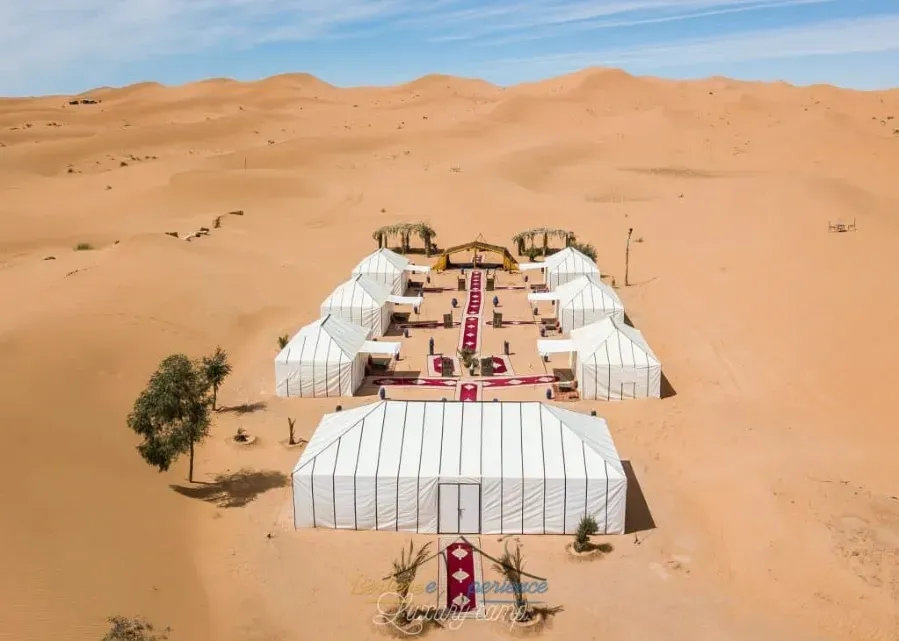
This is the source of more disappointment than any other single factor in Sahara desert tourism. Travelers see photographs of private tents with king beds, outdoor fire pits, and shower rooms with tiled floors. They pay for a "luxury" camp. They arrive to find a large communal tent with six mattresses on the ground, a shared toilet block twenty meters away, and a dinner of packaged couscous eaten under fluorescent strip lighting.
The word luxury is used by almost every camp in Merzouga regardless of what they actually offer. It is meaningless as a descriptor without specific details to back it up.
Here is what genuine mid-range and luxury camps actually provide, and what you should specifically confirm before you book.
A legitimate mid-range camp in the 800 to 1,500 dirham per person range should offer private tents for each couple or family group — not shared dormitory tents — with actual beds rather than floor mattresses, a functioning bathroom either en-suite or directly adjacent to your tent, electricity or reliable solar power for phone charging, and dinner that is freshly prepared rather than from packets. The tents should be insulated enough that you are comfortable sleeping in them at the temperatures typical of the season you are visiting.
A genuine luxury bivouac at 2,000 dirhams and above should provide all of the above plus en-suite bathroom facilities inside or directly attached to your private tent, high-quality bedding, a curated dinner menu with options, staff who are present and attentive rather than present and invisible, and a physical setting within the dunes rather than on their edge with a dune view from a distance. The distinction matters because some camps marketed as luxury are located close to the road and the village, which means you can hear motorbikes and see other lights at night. A genuinely well-positioned camp places you far enough into the dunes that the silence is complete and the stars are unobstructed by any ambient light.
At TravelEasyLife.com, every camp in their portfolio has been visited in person by the team. They can tell you specifically which camps have en-suite facilities, which have the best position within the dunes, which serve the best food, and which are genuinely worth the price difference. They do not list camps they have not seen, and they do not take commission from camps they cannot personally recommend. When you book a desert camp through them, what you are paying for is exactly what you arrive to find.
Thing 3: The Desert Is Freezing at Night — Even in Summer
Nobody warns first-time desert travelers about this adequately. The Sahara is one of the most extreme thermal environments on earth — not just hot, but dramatically variable between day and night. In April, the afternoon temperature might be 32 degrees. By midnight, it can be 8 degrees. In January, afternoon temperatures of 18 degrees are followed by nights that drop to 2 or 3 degrees. Even in August, when the day is ferociously hot, the desert night requires a layer.
This matters practically because many travelers pack for the daytime temperature they expect and then spend the night cold, which ruins the experience. The camel trek back at dawn — one of the most beautiful moments the desert offers — becomes an ordeal if you are shivering in a t-shirt.
The packing list for any Sahara desert trip should include a warm jacket or fleece regardless of when you are traveling, a merino wool or thermal base layer for sleeping, long trousers for evenings and early mornings, and closed shoes for the dunes. A light daypack is better than a rolling suitcase for the desert portion of the trip — leave the large luggage at your guesthouse in Merzouga and take only what you need for the night.
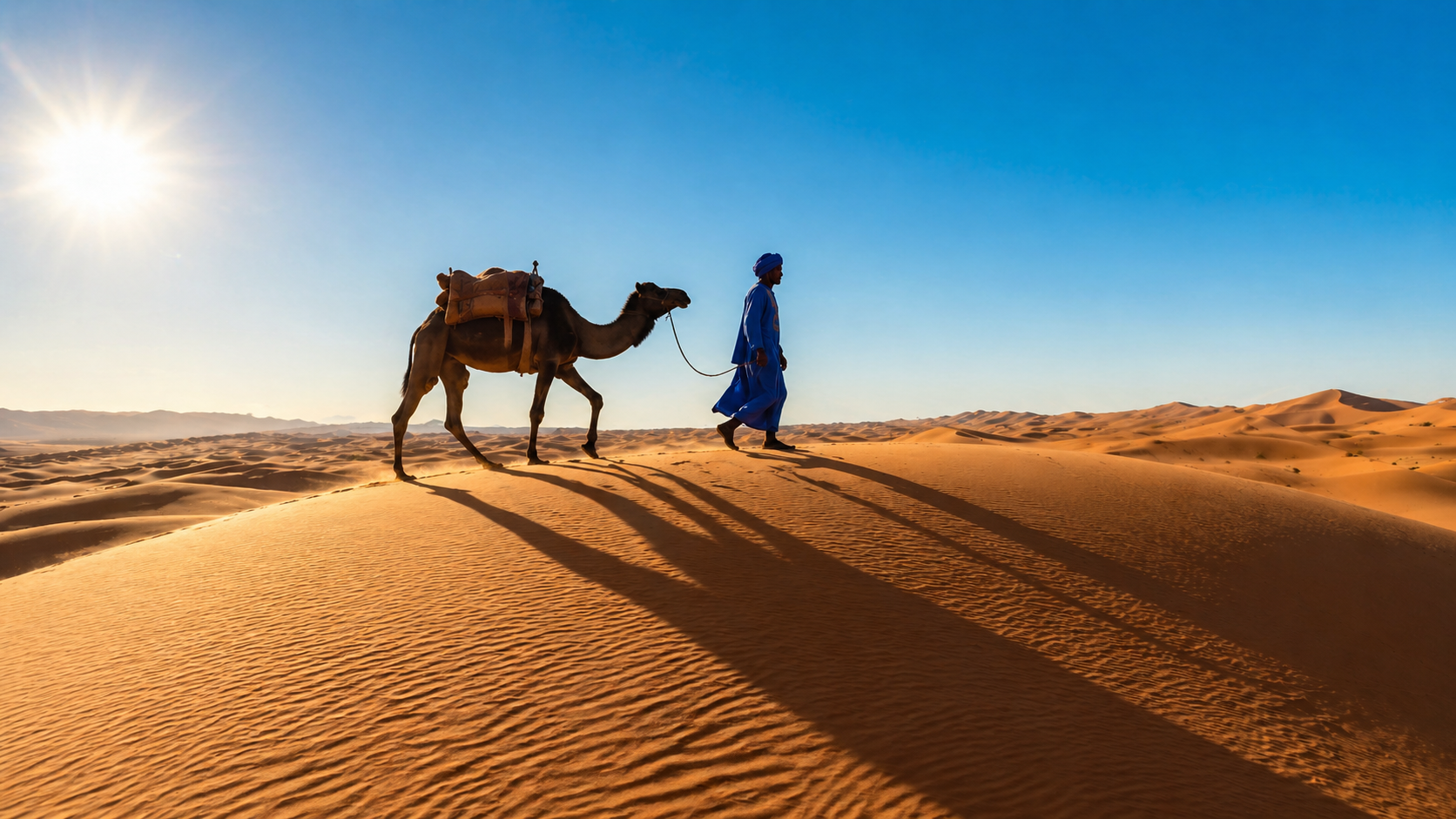
The cheche — the long Saharan scarf worn wrapped around the head and face by Tuareg and Berber men throughout North Africa — is one of the most practical things you can buy in Morocco and one of the most underrated. It costs 50 to 150 dirhams in any market in Merzouga or Rissani. Wrapped loosely around the head, it protects against sun during the day, wind-blown sand when the breeze picks up on the dunes, and cold at night when tied close. Camp staff will show you how to wrap it if you ask. Most visitors who buy one spend the rest of their Morocco trip wearing it.
A power bank is worth packing for the desert. Most camps have solar charging capability but the outlets are shared and often occupied. If photography or communication matters to you, arrive with a full power bank rather than depending on camp electricity.
Thing 4: Camel Trekking Prices Are Not Fixed — And the Gap Is Enormous
The official price for a standard one-hour camel trek in Merzouga — the kind most visitors do, riding into the dunes at sunset and returning at dark — is between 150 and 250 dirhams per person when booked through a reputable operator or included in a package.
The price for the same camel trek when booked spontaneously with an unaffiliated tout at the edge of the dunes can be 800, 1,000, or 1,500 dirhams per person, presented with great confidence and a laminated price list that was printed that morning.
This is the most common pricing disparity in Merzouga and it catches travelers who arrive without having booked anything in advance, particularly those traveling independently. The solution is simple: book your camel trek in advance through your guesthouse, your camp, or a trusted operator like TravelEasyLife.com. The price is agreed before you arrive, there is no negotiation at the dune edge, and you can focus on the experience rather than on whether you are being taken advantage of.
The broader principle applies to everything in the Merzouga area: quad bikes, 4x4 excursions, guided walks, and even bottled water have significant price variation depending on where and how you buy them. Travelers who arrive with their activities pre-arranged through a local partner consistently spend less and experience more than those who figure it out on arrival.
Thing 5: The Two-Day Desert Trip Is Almost Always a Mistake
Travelers with tight schedules frequently ask whether the Sahara can be done in two days from Marrakech — drive down on day one, sleep in the desert, drive back on day two. Technically yes. In practice, this is one of the most common sources of disappointment in Morocco tourism.
The maths are straightforward and unfavorable. Drive from Marrakech to Merzouga: nine to ten hours. Arrive late afternoon, ride camels, sleep at camp, wake at dawn. Drive back to Marrakech: nine to ten hours. Total time in the desert: roughly twelve hours, of which six are sleeping. Total time driving: eighteen to twenty hours across two days.
The travelers who do this trip come back saying the desert was beautiful but they felt exhausted and somehow cheated — like they saw something magnificent through a car window at speed. They are right to feel that way.
Three days and two nights is the minimum that allows you to actually be in the Sahara rather than to pass through it. The second day — no driving, nowhere to be — is when the desert actually reveals itself. You walk into the dunes alone in the early morning. You visit Khamlia in the afternoon. You watch the light change across the sand from the same position at different hours and understand why painters have been trying to capture this landscape for centuries. You sleep in the desert twice and the second night you are not thinking about the journey or the logistics — you are just there.
If your schedule genuinely only allows two days, the best adaptation is to fly from Casablanca or Marrakech to Errachidia — the flight takes one hour — and then transfer directly to Merzouga. This eliminates the overland journey entirely and gives you more time in the desert itself within the same window. TravelEasyLife.com can organize this combination of domestic flight and desert package and it makes a two-day desert trip genuinely worthwhile in a way that the road journey version usually does not.
Thing 6: Signal, Internet, and the Question of Disconnecting
One of the most frequently asked practical questions about the Merzouga desert is whether there is phone signal in the dunes. The honest answer is: it depends on your position and your carrier.
In Merzouga village and at most guesthouses on the edge of the dunes, Maroc Telecom has reliable 4G signal. Orange Morocco has decent coverage. Inwi is more variable. Once you ride into the dunes by camel — typically one to two kilometers from the camp — signal drops to zero on most networks, which is part of what makes the experience what it is.
Most travelers report that the absence of signal in the dunes is one of the things they appreciate most about the Sahara experience, even those who were anxious about it before they arrived. There is no scroll, no notification, no obligation to photograph and caption and share in real time. There is the sand, the sky, the fire, and the people you are with. For many visitors from heavily connected lives, it is the first genuine disconnection they have experienced in years.
If you need to inform family of your whereabouts or require connectivity for work reasons, stay connected at the guesthouse before you ride into the dunes, leave your itinerary with someone, and understand that the next communication opportunity will be after your dawn camel trek back to the camp.
Thing 7: The People You Meet in the Desert Are as Important as the Landscape
This is the thing that almost no travel article mentions because it is harder to photograph and harder to quantify. The Berber communities of the Merzouga area — the guides who lead the camel treks, the families who run the guesthouses, the musicians in Khamlia, the artisans in Rissani — are as much a part of the Sahara experience as the dunes themselves, and the quality of your interactions with them is largely determined by how you approach them.
Travelers who arrive with genuine curiosity — who ask their camel guide his name and where he grew up, who stop in Khamlia long enough to actually listen to the music rather than record thirty seconds of it, who sit with the family who cooked their dinner and ask about the ingredients — consistently describe the desert experience as transformative rather than merely impressive. The landscape is extraordinary. The people who live within it and around it are what make it human.
This is also, practically speaking, why booking through a local Moroccan operator rather than an international platform matters beyond just price and logistics. When your trip is organized by people from Morocco who have relationships with the communities in Merzouga, those introductions carry weight. The camel guide who takes you into the dunes is not a stranger assigned by an algorithm — he is someone whose family the team at TravelEasyLife.com has worked with for years. The camp where you sleep is run by people who know your operator by name. These connections shape the quality of the experience in ways that do not appear on any itinerary.
Frequently Asked Questions
Is there phone signal in the Sahara desert near Merzouga? In Merzouga village and at the guesthouses on the edge of the dunes, Maroc Telecom and Orange Morocco provide reliable 4G signal. Once you are one to two kilometers inside the dunes on a camel trek, signal typically drops to zero. Most travelers find this one of the best parts of the experience.
Can I do the Sahara in 2 days from Marrakech? Technically yes, but it means spending 18 to 20 hours driving for roughly 12 hours in the desert — 6 of which are sleeping. Almost everyone who does this feels the trip was too rushed. Three days minimum is the honest recommendation. If two days is your only option, fly to Errachidia instead of driving from Marrakech and contact TravelEasyLife.com to organize the flight-plus-desert package.
What is the difference between a standard and luxury desert camp? Standard camps offer shared tents, floor mattresses, and shared bathrooms. Genuine luxury camps offer private tents with real beds, en-suite or adjacent private bathrooms, quality food, and a location within the dunes rather than on their edge. The word "luxury" is used by almost every camp regardless of what they offer — always ask for specific details or book through an operator who has visited the camps in person.
How much does a Sahara desert tour from Marrakech cost? A budget 2-day shared tour with a standard camp costs approximately 1,500 to 2,000 dirhams per person including transport and one night. A private 3-day tour with a mid-range camp runs 3,500 to 6,000 dirhams per person. A private luxury 3-day experience costs 8,000 to 15,000 dirhams per person. TravelEasyLife.com provides transparent pricing across all three tiers with no hidden fees.
What is the best time of year to visit the Sahara in Morocco? October through May offers the best conditions — warm days, cool nights, and manageable temperatures for camel trekking and walking in the dunes. March and April are widely considered the peak season for beauty and comfort. June through September is possible but the midday heat regularly exceeds 45°C and limits the hours you can comfortably spend outside the camp.
Is it safe to travel to Merzouga alone as a solo traveler? Yes. Merzouga is one of the safest areas of Morocco for solo travelers. The community depends on tourism and is welcoming and hospitable. Solo female travelers are generally comfortable and the guesthouse owners are attentive and helpful. Booking through a reputable operator adds an additional layer of support — you have a local contact who knows where you are and can assist if anything unexpected arises.
What should I pack for a Sahara desert overnight? Warm jacket or fleece, thermal base layer, long trousers, closed shoes, hat, high-SPF sunscreen, lip balm, headlamp, power bank, more water than you think you need, and a small daypack. A cheche scarf — available for 50 to 150 dirhams in Merzouga — is one of the most useful items you can bring and makes for an excellent photograph.
.jpg&w=3840&q=75)