The Taxi Overcharge — Morocco's Most Common Tourist Experience
Let us start with the most universal experience in Moroccan tourism, because it happens to almost every first-time visitor and sets the tone for how anxious or confident the rest of the trip feels.
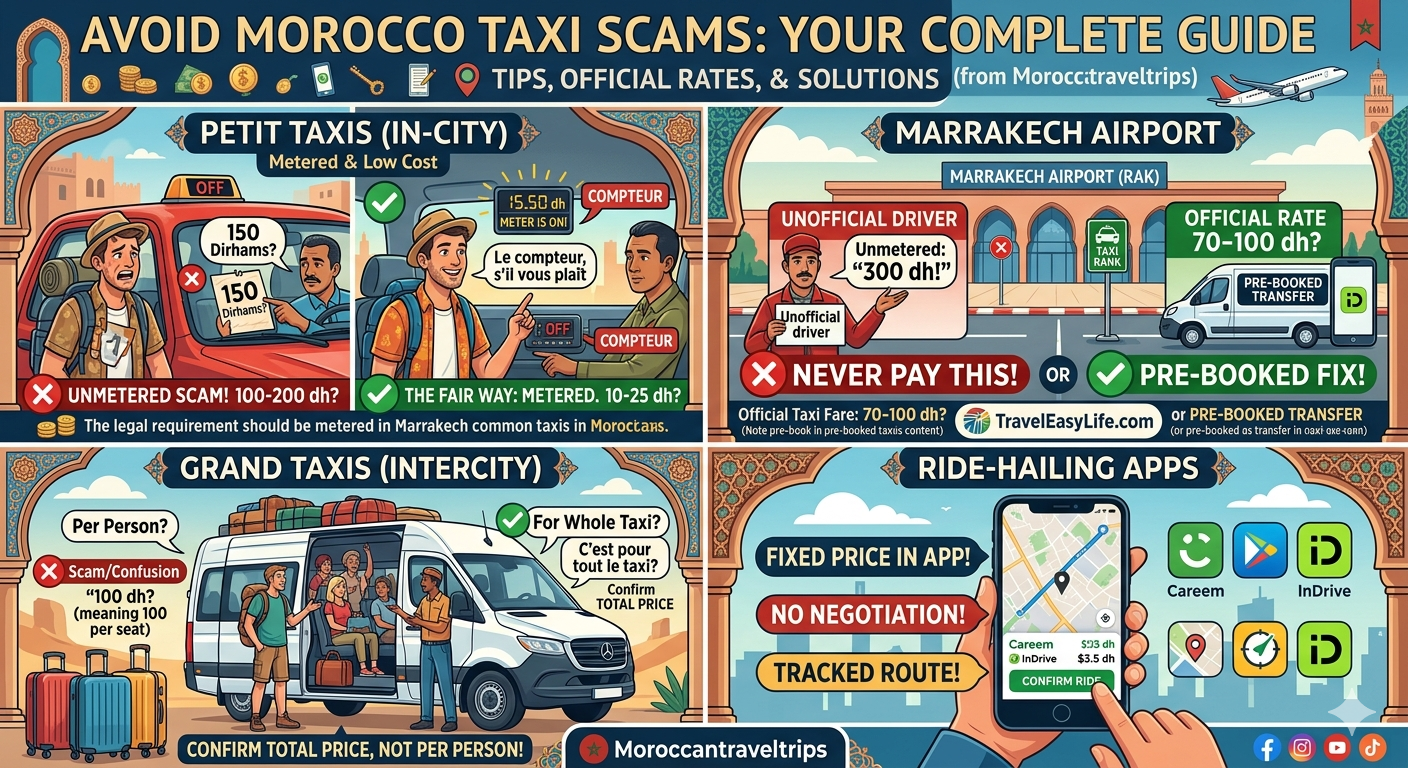
Petit taxis — the small city taxis in Marrakech, Fes, Casablanca, and other cities — are legally required by Moroccan law to use a meter. The meter is called a compteur in French and a 'adad in Arabic. A cross-city trip in Marrakech with the meter running costs between 10 and 25 dirhams depending on distance and time of day. The same trip without the meter, agreed as a flat rate with a tourist who does not know the fair price, costs 100, 150, or 200 dirhams.
When you get into a petit taxi, say immediately and firmly: "Le compteur, s'il vous plaît" — "The meter, please." If the driver says the meter is broken, says he prefers a fixed price, or ignores you, get out. There is always another taxi. The meter being "broken" is almost never true — it is a test to see whether you know your rights.
The Marrakech airport route deserves specific mention because it is where the disparity is largest and most documented. Unofficial drivers outside the terminal can quote 300 to 400 dirhams for the airport-to-medina route. The official fare is around 70 to 100 dirhams depending on time of day. Pre-booking your airport transfer before you land eliminates this problem entirely. TravelEasyLife.com arranges airport transfers at fixed, transparent rates with professional licensed drivers who meet you at arrivals — you see the price before you book and pay nothing more on arrival. Moroccantraveltrips
For grand taxis — the shared intercity taxis that run between cities — meters do not apply, and agreeing a price before you get in is standard practice. The important thing here is to confirm that the price is for the whole vehicle, not per person. The classic confusion is that a driver quotes "100 dirhams" meaning 100 per seat when you thought it meant 100 total. Confirm with: "C'est pour tout le taxi?" — "That's for the whole taxi?"
Ride-hailing apps are the easiest solution in cities where they operate. Careem works in Casablanca, Marrakech, and Rabat. InDrive operates in several Moroccan cities. The price is agreed in the app before you get in, there is no negotiation, and the route is tracked on your phone. For anyone who finds taxi negotiation stressful, these apps remove the entire problem.

The Fake Guide in the Medina — And Why It Works
The medinas of Marrakech and Fes are UNESCO World Heritage sites and among the most extraordinary urban environments on earth. They are also genuinely confusing for first-time visitors. Google Maps works poorly inside the narrow lanes. Street signs are sparse. Every alley looks like every other alley. And someone who offers to help you find your riad when you are hot, tired, and carrying a bag is very difficult to refuse.
The unofficial guide scam is Marrakech's defining pattern: a local approaches tourists near the entrance to the medina, claims to be "going the same way," and provides unrequested navigation assistance before presenting a bill. Beforeyougotravels
The way it unfolds is consistent. A friendly person — often a young man, often speaking good English or French — sees you looking at your phone near a medina gate. He asks where you are going, says he is heading that direction, and walks with you. The conversation is pleasant. He might point out a landmark, make a joke, explain some history. Ten minutes later, when you reach your destination or a shop, he presents a bill — 100 dirhams, 200 dirhams, sometimes more — for "guide services." If you refuse, the interaction can become uncomfortable.
The solution requires overriding the social instinct to accept help. When someone approaches you unsolicited in a tourist area and offers directions or assistance, the correct response is a polite but firm: "Non merci, je suis bien" — "No thank you, I am fine." Do not engage with the conversation. Do not follow them. If you are genuinely lost, walk into a shop — any shop — and ask the shopkeeper for directions. Shopkeepers cannot leave their stores and have no incentive to lead you anywhere.
If you want a genuine guided medina experience — which is worth doing, because a knowledgeable guide transforms a confusing maze into a coherent story — book a licensed guide in advance through your riad or through TravelEasyLife.com. Licensed guides carry official government-issued credentials, charge transparent pre-agreed rates (typically 300 to 500 dirhams for a half-day private tour), and are accountable through a formal professional system. The difference in experience quality between a licensed guide and a street tout is as large as the difference in price transparency.
The Henna Trap — How to Walk Past It
Jemaa el-Fna square in Marrakech is one of the most vibrant public spaces in the world. It is also where the henna trap operates, consistently and effectively, on tourists who do not know what is coming.
A woman — usually in traditional dress, holding a cone of henna paste — approaches you, takes your hand, and begins drawing a design on your wrist before you have agreed to anything. The design takes thirty seconds. Then she demands payment. The amount she names is typically 200 to 500 dirhams for something that cost her ten dirhams of materials and thirty seconds of time. If you refuse or offer less, she may become loudly aggressive or call others over.
The most common Marrakech scams include the henna trick where women grab your hand and apply henna then demand 200 dirhams or more. CityGuide
The only reliable prevention is physical: keep your hands in your pockets or crossed over your body when walking through the square, and when you see henna artists approaching, make eye contact briefly and shake your head once. If someone takes your hand anyway, pull it back immediately before they begin drawing. Once the henna is on your skin the social pressure becomes very difficult to navigate.
If you want a henna design — and Moroccan henna is genuinely beautiful, a lovely thing to have on your hand for a holiday — go to a reputable salon inside the medina that displays prices on a board and has indoor seating. Prices at legitimate establishments start at 50 dirhams for a small design and go up based on size and complexity. TravelEasyLife.com can recommend vetted henna artists in Marrakech and Fes who charge fair prices and use natural paste.
Camel and Horse Rides — The Stranding Tactic
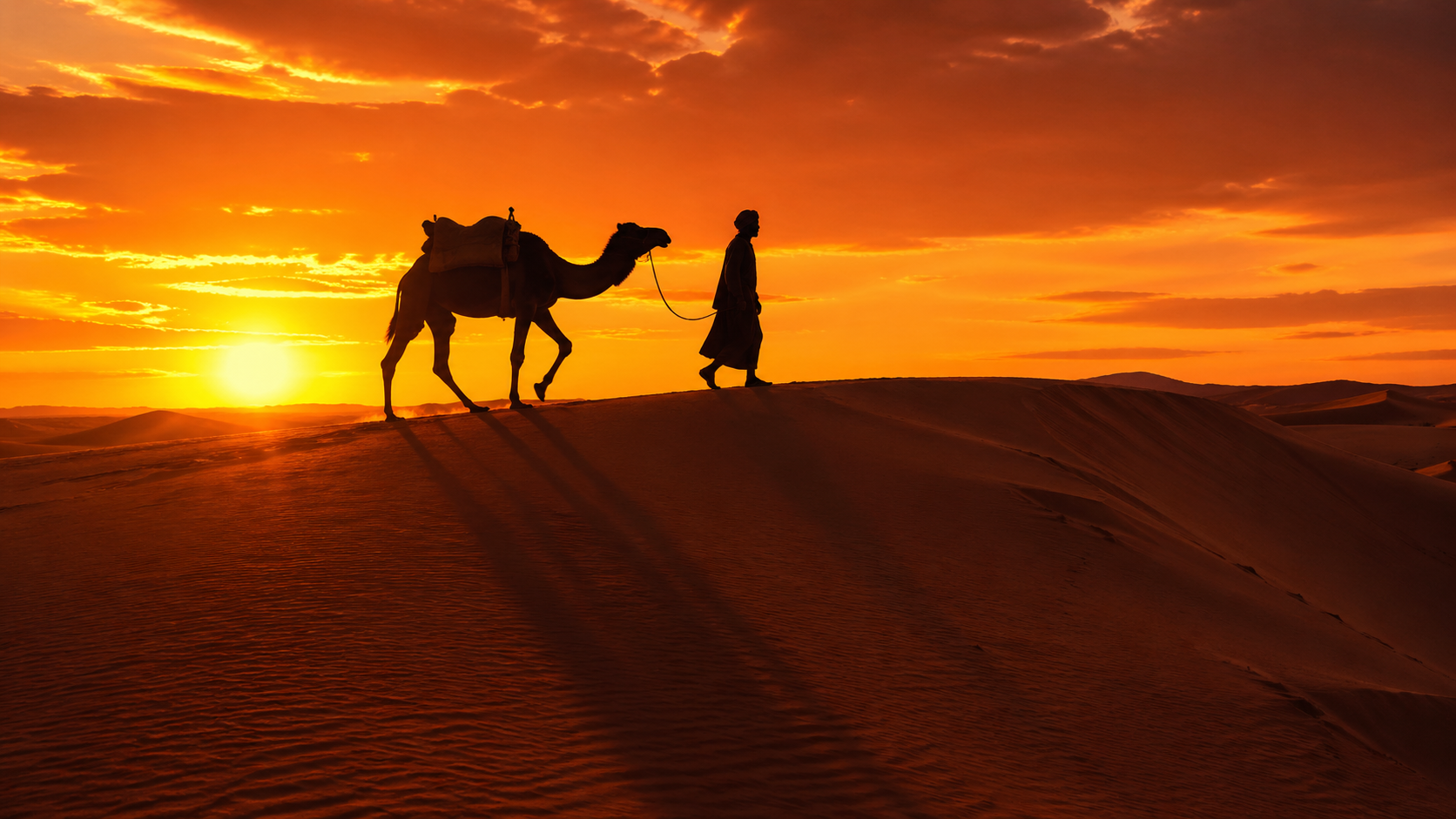
Around tourist areas — particularly near the Palmeraie in Marrakech, near the dunes in Merzouga, and along coastal roads near Agadir — independent camel and horse operators approach tourists offering rides. The pricing conversation happens before you mount, but the problem often begins after.
A variant of this scam involves the camel owner bringing you very far from your starting point and then demanding double the payment in order to return you to the village you started from. This can be a very stressful experience. Journal of Nomads
The other common version is simpler: an agreed price of "100 dirhams" turns out to mean 100 dirhams per person when you understood it as 100 total, or the "one-hour ride" somehow becomes a two-hour ride that costs double.
The prevention is straightforward: only book camel and horse rides through your accommodation, through an organized tour, or through a platform like TravelEasyLife.com where the price, duration, and route are confirmed in writing before you leave. At Merzouga specifically, camel treks booked through reputable operators cost 150 to 250 dirhams per person for a standard one-hour sunset or sunrise trek — not 800 or 1,000. If an independent operator at the edge of the dunes is quoting you significantly more, you are looking at a tourist rate, not a fair rate.
The "It's Closed" Redirect
This scam begins with a local claiming that a popular attraction, an alley in the medina, or a souk is closed. He then begins guiding you to another location — often a restaurant or shop where he will receive a commission. Backpack Moments
You will encounter this most commonly near the tanneries in Fes, near the entrance to Jemaa el-Fna, and near the main gates of both Marrakech and Fes medinas. Someone approaches, tells you with apparent authority that the tannery is closed today, the square is under renovation, the souk you want is in the other direction — and offers to show you something "better."
The response is simple: thank them, and continue walking in the direction you were heading. If you have any doubt, take out your phone and look it up or call your riad to confirm. Major attractions in Morocco almost never close without advance notice, and they do not close based on what a stranger tells you on the street.
The tanneries of Fes deserve a specific note because the scam there has a particular structure. The genuine Chouara Tannery is accessible through the leather shops that overlook it — you enter through a shop, they give you a sprig of mint, you view the dyeing pits from above, and you are welcome to buy leather goods (at negotiable prices) but are not obligated to. There is no entry fee to the view. If someone is asking you to pay an entry fee before you see the tannery, or telling you that the "real" tannery is elsewhere and they will take you there, decline and find a leather shop with an obvious view of the pits yourself.
Currency Exchange — Where the Real Money Gets Lost
Currency exchange scams work when a friendly local approaches you offering a great exchange rate — better than the banks and official money exchange offices. Once your cash is in their hands, the scammer may return a portion of the money, potentially less than 50% of the actual value, or hide counterfeit money within real notes. Theendlesstravellers
The simple rule: never exchange money with anyone who approaches you on the street, regardless of how attractive the rate sounds. Always use official Bureau de Change offices — identifiable by a government-issued license displayed in the window — or bank ATMs.
ATMs in Morocco dispense dirhams and are widely available in city centres and at airports. The exchange rate applied by international ATMs is generally fair and usually better than airport exchange counters. Withdraw a useful amount on arrival at the airport ATM (which offers better rates than the exchange desks nearby) and supplement at bank ATMs in the medina as needed.
Always count your notes in full view and in good light before leaving any exchange counter. Count them twice. Folded notes and notes of different denominations can obscure the actual amount received. This is basic practice that prevents the single most common form of currency scam.
Fake Argan Oil, Spices, and Souvenirs — What Is Real and What Is Not
Morocco produces some of the world's finest argan oil, saffron, and hand-crafted goods. It also produces a significant quantity of imitations of all three.
Much of the merchandise sold at Morocco's markets and souks is fake. Argan oil is often diluted, leather may be artificial, rugs may be machine-made, saffron is nearly always adulterated. Backpack Moments
Genuine culinary argan oil is a deep amber-gold color with a rich nutty smell. Cosmetic argan oil is pale and nearly odorless. Oil that is very cheap, very pale, or very mild in smell has almost certainly been diluted with cheaper oils. Buy argan oil directly from women's cooperatives — there are genuine ones in Marrakech, Essaouira, and on the road south toward Agadir — where you can watch the pressing process and the price reflects real production costs. A 100ml bottle of genuine culinary argan oil costs between 80 and 150 dirhams from a cooperative. If it costs 30 dirhams from a souk vendor, it is not genuine.
Saffron sold in Moroccan souks is almost universally fake or heavily diluted. Real Moroccan saffron — from the Taliouine region in the Anti-Atlas, one of the world's finest — is expensive because it is incredibly labor-intensive to produce. A gram of genuine saffron costs between 30 and 60 dirhams. A 5-gram bag offered for 20 dirhams is either safflower petals dyed red, or saffron mixed with so much filler it has no culinary value. Buy saffron from specialist spice shops with clear provenance labeling, not from general souk stalls.
For carpets, leather goods, and ceramics — the standard advice applies: assume you are being quoted the tourist starting price, not the fair price, and bargain from there. A useful starting approach is to express genuine interest, ask the price, and offer 40 to 50 percent of what you are quoted. The final price, after a good-natured negotiation, will typically be somewhere between 50 and 70 percent of the opening ask. This is not adversarial — it is the expected social ritual, and most shopkeepers enjoy it. What they find genuinely frustrating is someone who asks the price, haggles aggressively, and then does not buy. If you open a negotiation, be prepared to purchase if you reach a price you are happy with.
Restaurant Price Padding — The Bill You Did Not Order
Many travelers share cautionary tales about receiving unexpectedly high bills from ordinary restaurants. Unless opting for street food, always ask for the menu, and if they say they do not have one, ask for the price upfront. 24camels
The most common version of this in tourist areas is the addition of items to your bill that you did not order — bread that was brought automatically to the table and billed at 15 dirhams per person, olives placed down without being requested and billed at 20 dirhams, mineral water assumed rather than offered. None of these individually is a significant sum. Together, on a table of four people, they can add 150 to 200 dirhams to a bill.
The prevention is to review the menu before you order, ask the price of anything brought to the table that you did not request, and check your bill line by line before paying. If you see items you did not consume, point them out calmly — "Je n'ai pas commandé ça" ("I didn't order that") — and most restaurants will remove them without confrontation. You are within your rights to do this.
Restaurants immediately adjacent to major tourist attractions in Marrakech and Fes charge significantly more than restaurants two streets away. This is not a scam per se — it is economics — but the markup can be 40 to 60 percent for the same quality of food. Walk two minutes away from Jemaa el-Fna and the price of a tagine drops from 120 dirhams to 65. Walk five minutes away from the main tannery viewing area in Fes and the same principle applies.
New Scams in 2025–2026 That Most Guides Do Not Cover
Based on current traveler reports from 2025 to 2026, newer scams include AI-generated fake tour agencies on social media that collect deposits and vanish, QR code phishing at tourist sites where fake codes redirect to payment pages, and online romance scams targeting solo travelers before they even arrive. Moroccantraveltrips
The social media agency scam is worth specific attention for anyone booking from abroad. A convincing Instagram or Facebook profile, professional-looking photos (often AI-generated or taken from legitimate agencies), and a responsive WhatsApp number can create the appearance of a legitimate tour operator. They take a deposit — usually 30 to 50 percent of the tour cost — and either disappear entirely or turn up in Morocco as a very different, much lower quality service than what was promised.
The protection is straightforward: only book with agencies that have verifiable reviews on platforms like Google Maps, TripAdvisor, or Booking.com, have a physical address you can verify, have been operating for multiple years, and can provide references from recent travelers. TravelEasyLife.com is a registered Moroccan travel platform with verifiable contact information, transparent pricing, and a team based in Morocco whose names and faces you can look up. Before you send a deposit to any Moroccan travel operator, confirm these things.
The Real Prices — What Everything Should Actually Cost
This is the section most travel blogs do not include because they do not know. We are Moroccan. We know.
A petit taxi across Marrakech medina: 10 to 25 dirhams. From the airport to the medina: 70 to 100 dirhams. From Marrakech train station to a medina riad: 20 to 35 dirhams.
A camel trek at Merzouga (one hour, sunset or sunrise): 150 to 250 dirhams per person when booked through a reputable operator.
A genuine half-day private licensed guide in Marrakech or Fes: 300 to 500 dirhams.
A standard tagine in a non-tourist restaurant: 50 to 80 dirhams. In a mid-range tourist restaurant: 90 to 130 dirhams. Adjacent to Jemaa el-Fna: 120 to 180 dirhams.
A decent riad double room in Marrakech medina: 400 to 700 dirhams per night including breakfast.
A hammam experience in a genuine local hammam (not tourist spa): 15 to 30 dirhams for the basic wash, 30 to 50 dirhams with a kessa scrub and savon beldi. Tourist hammams in riads charge 200 to 400 dirhams for essentially the same experience with nicer tiles.
Souvenir leather slippers (babouches) in the souk: start negotiating at 40 dirhams and expect to pay 50 to 80 for good quality. The opening price from most vendors is 150 to 200.
A one-hour quad bike ride in the Sahara dunes: 350 to 500 dirhams.
Genuine culinary argan oil, 100ml from a cooperative: 80 to 150 dirhams.
If You Have Already Been Scammed — What to Do
Most tourist scams in Morocco are financial and the amounts involved are small. Losing 50 dirhams on overpriced spices is a learning experience, not a crisis. Most tourist scams in Morocco are financial — overcharging, fake goods — rather than dangerous. CityGuide
For significant incidents — a large sum of money, counterfeit goods sold as genuine, threatening behavior — Morocco has a dedicated Brigade Touristique (tourist police) that operates in every major city and takes complaints seriously. Morocco's tourism reputation is a national priority and the government invests in protecting it. You can also report through your riad — the owner will often know the shop or person involved, can mediate in Arabic, or can accompany you to the police station.
For smaller overcharges, the most useful mindset is the one experienced Morocco travelers develop quickly: you are navigating a negotiation culture where your knowledge of fair prices is the most valuable thing you can carry. Every dirham you overpay today is a lesson that costs almost nothing in the context of a trip that will cost thousands. The goal is not to win every transaction — it is to engage with Morocco confidently, pay fair prices, and spend your mental energy on the extraordinary country around you rather than on defensive vigilance.
The travelers who enjoy Morocco most are the ones who arrive informed, travel with a reputable local partner for the major logistics, and approach the culture — including its negotiation aspects — with curiosity rather than anxiety.
TravelEasyLife.com exists precisely to remove the anxiety from the logistics. Every tour price is published before you book. Every driver and guide is vetted and licensed. Every hotel and camp has been visited by the team. You know exactly what you are getting and exactly what you will pay. That transparency is not just good business — for a first-time visitor to Morocco, it is the difference between arriving nervous and arriving ready to fall in love with the place.
follow our youtube channel
.jpg&w=3840&q=75)